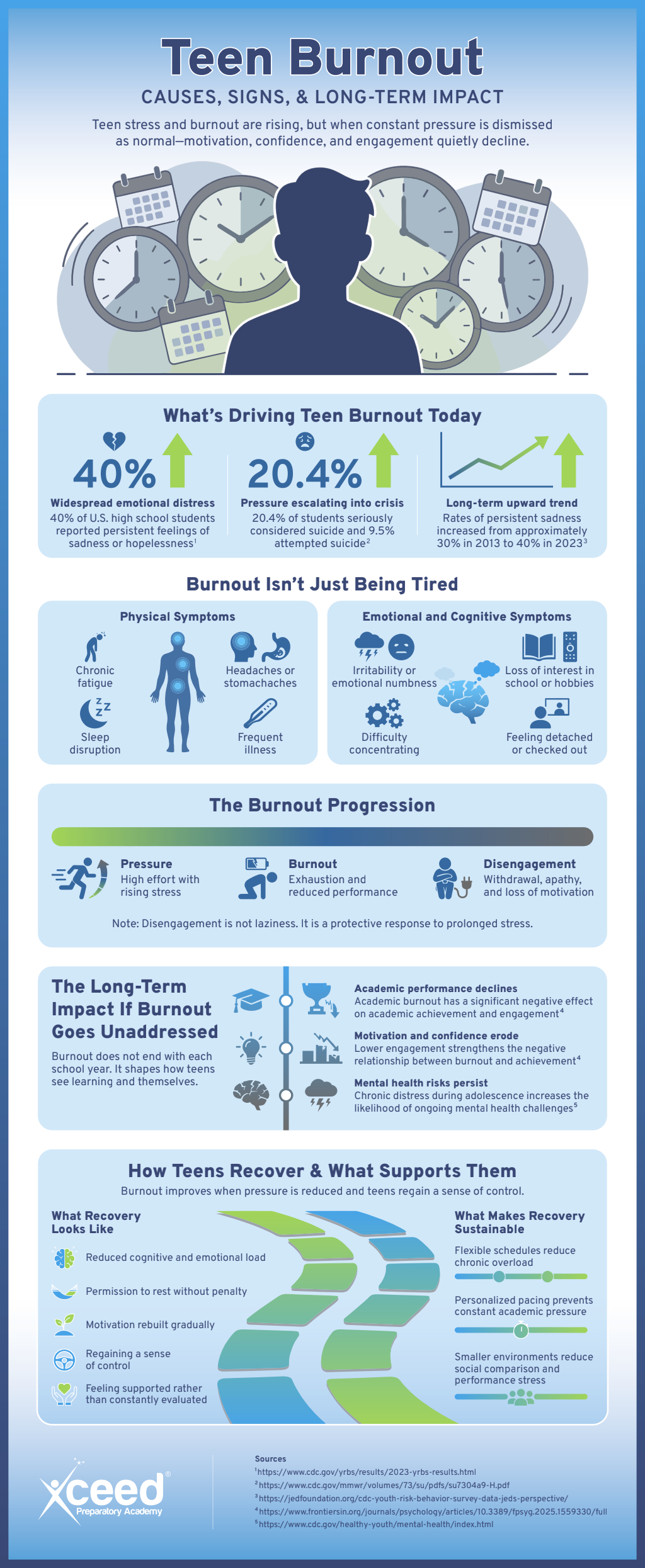

Teen burnout is often misinterpreted as a lack of motivation or effort. In reality, it is a signal that something within the learning environment is not aligned with a student’s needs. It points to an imbalance between expectations and capacity, structure and independence, pressure and recovery.
For many adolescents, the demands of school extend well beyond academics. Long schedules, constant assessments, social pressures, and limited control over how work is completed can overwhelm even highly driven students. When every assignment feels urgent and every result carries weight, stress stops being helpful and begins to take a negative toll.
Burnout does not present the same way for every student. Some teens may appear visibly tired or frustrated, while others withdraw, become quieter, or seem emotionally detached. These changes can be subtle and are often mistaken for typical teenage behavior. Over time, however, ongoing stress can shift how students engage with learning. Curiosity may fade, confidence can decline, and effort may start to feel ineffective.
The Impact of Rigid Learning Models
A key contributor to burnout is the lack of flexibility in traditional educational structures. Students differ in how they learn, manage their energy, and respond to pressure. Those with individualized education plans may face additional challenges when supports are not consistently applied or when environments lack adaptability. Even students without formal accommodations can struggle in systems that move at a fixed pace or emphasize output over understanding.
This is where more flexible and personalized private school learning approaches can make a difference. When students have greater control over pacing, workload, and how they demonstrate knowledge, stress becomes more manageable. Blended learning models can also provide balance, allowing students to engage with material in different ways while receiving appropriate support.
Rebuilding Balance Without Reducing Expectations
Addressing burnout is not about lowering standards or removing challenges. It is about creating balance. Students need opportunities to rest without feeling like they are falling behind. They need environments where seeking help is encouraged rather than discouraged. Most importantly, they need to be recognized as individuals, not just as data points or averages.
Supportive learning environments acknowledge that progress is not always linear. Motivation often returns gradually when students feel supported, capable, and in control of their learning. Smaller class settings, consistent relationships, and thoughtful pacing can help rebuild trust and reengage students.
Burnout is not a personal shortcoming. It is a form of feedback. When educators and families respond to that feedback, they can create conditions where students are both challenged and supported, allowing them to reconnect with learning in a healthier and more sustainable way.