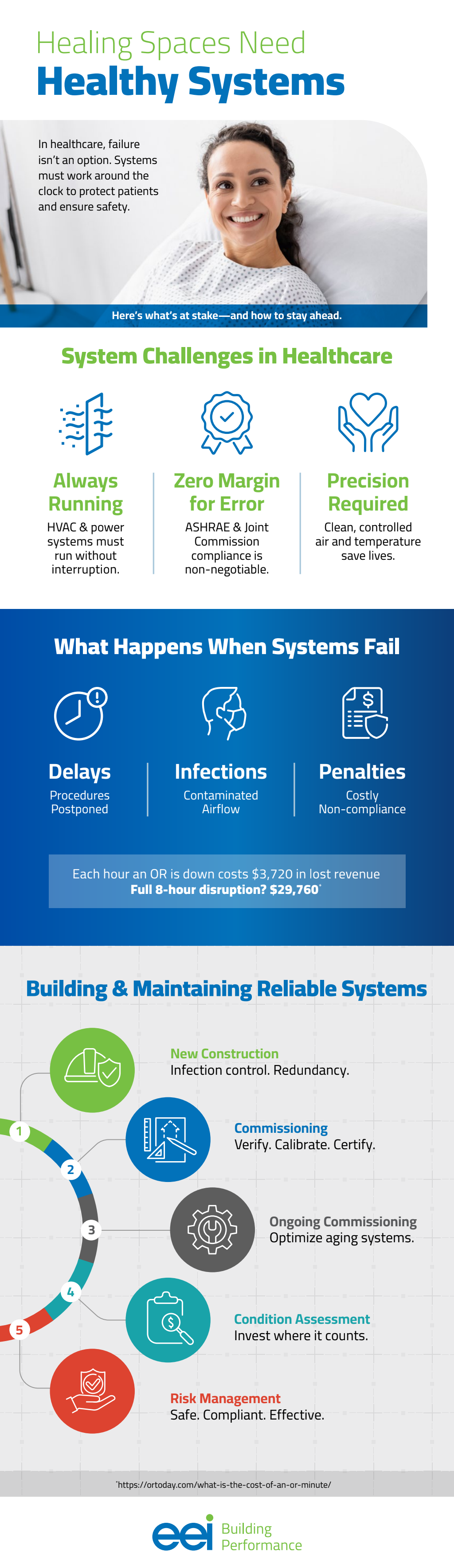

Healthcare environments are designed to promote healing, deliver accurate treatment, and maintain safe conditions for patients and staff. Behind every successful clinical operation is a network of infrastructure systems working continuously to support these goals. HVAC performance, electrical reliability, pressure management, and high-grade filtration all contribute to a facility’s ability to provide dependable care. When any of these systems weaken or stop functioning, the impact is immediate and felt throughout the entire building.
In medical settings, system interruptions create risks that go far beyond inconvenience. Downtime can affect patient health, staff safety, and the overall stability of daily operations. Hospitals and clinics operate under some of the most demanding conditions of any facility type, with constant occupancy, specialized equipment, strict environmental requirements, and changing patient volumes. Because of this, HVAC and electrical systems must maintain consistent performance. Even minor variations in temperature, humidity, or ventilation can influence infection risk, affect recovery, or disrupt essential procedures.
Building Resilience Through Thoughtful Design and Ongoing Oversight
Reliable healthcare infrastructure begins with smart decisions during the planning and design phases. Choices related to zoning, redundancy, filtration capability, and pressurization shape how well systems perform over time. Different parts of a healthcare facility have distinct needs. Operating suites, isolation areas, laboratories, and waiting spaces each require specific environmental controls to function safely.
After construction, continuous oversight becomes critical. Building commissioning, system monitoring, and proactive maintenance help ensure that equipment operates as intended as the facility grows and changes. Healthcare organizations frequently bring in new technologies, expand services, or shift clinical workflows, which places additional pressure on building systems. Tools such as advanced diagnostics, performance analytics, and service contracts grounded in real-time data help keep infrastructure aligned with current operational demands.
Effective infrastructure management also depends on collaboration among multiple disciplines. Facility teams, engineers, infection prevention specialists, and clinical staff must work together to ensure that building systems support daily use. Human expertise and routine operational awareness are as important as the mechanical systems themselves.
Ultimately, the goal is an environment where infrastructure supports care rather than interrupts it. When systems perform reliably, healthcare teams can focus on patients. When they break down, attention shifts from healing to crisis response. That is why infrastructure should be considered a strategic investment that reinforces the core mission of healthcare.
To dive deeper into how environmental systems underpin patient care, see the accompanying visual guide on healthcare infrastructure performance from Engineering Economics, a decarbonization consulting service.